Emulsion, suspension, emulsifier, Lubrication additives, graphite antioxidants



Information
11-22
What emulsifiers are commonly used in pesticides?
Super saponification capability of lotion polymerization, and various oil stains have strong saponification, emulsification, decontamination and decontamination capabilities. It is widely used in various industries.

11-22
What is the role of pesticide emulsifier
Make pesticides in the form of emulsifiable concentrates or microemulsifiable concentrates more soluble in water. If there is no emulsifier, this kind of pesticide is prone to separation and stratification when mixed with water, which will reduce the effect.
07-28
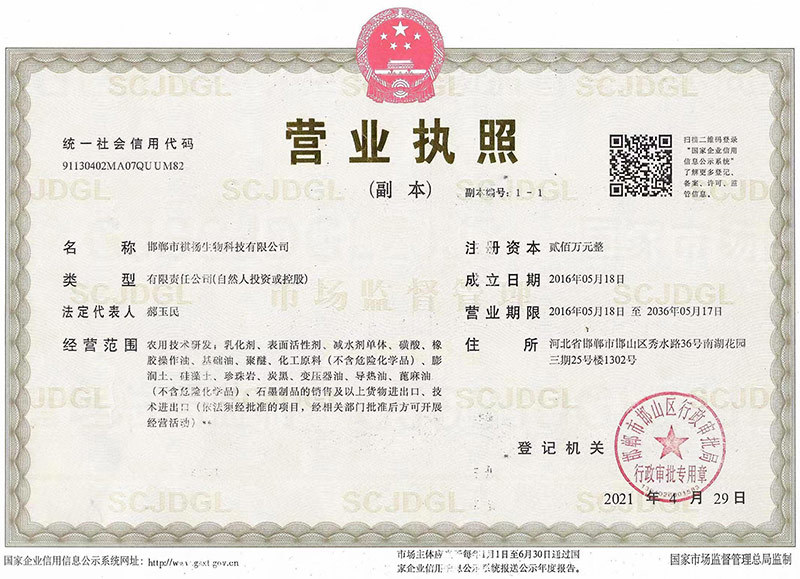
Handan Qiyang Biological Technology Co., Ltd. is a high-tech enterprise focusing on production, R&D and sales. Advanced process equipment, strong technical force, complete experimental testing, the products are mainly used in pesticides, washing, textile printing and dyeing and other fields. The products are sold all over the country. The abamectin thickening emulsifier produced is currently the world leader and is exported to the world. It is well received by users everywhere.
01-10
What are the commonly used emulsifier monomers for pesticides?
1. Super strong saponification and emulsification polymerization ability, very strong against various oil stainsSaponification, emulsification, cleaning and cleansing capabilities. It is widely used in a variety of industries. 2. Unique dual-core polymerization of saponification and emulsification, which can complete the previous single saponification andA function that cannot be accomplished by emulsification alone. 3. The world’s first use of slow-release factors can make super saponified emulsifiers last foreverVolatile saponification and emulsification. And can be recycled again and again to make super saponificationThe emulsifier has its full effect. 4. Adding a little super saponified emulsifier can be great in detergents and other detergentsImprove the ability of continuous saponification and emulsification of oil and oil. Suitable for any formula.
11-12
What are the commonly used emulsifiers in pesticide formulations?
Surfactant is an important component of pesticide additives, and its molecule has two polar groups of hydrophilic group and lipophilic group. According to the electronic state, hydrophilic groups are divided into 4 types: anionic, cationic, nonionic and diionic. Surfactants can make the solution form an interface state through the balance of hydrophilicity and lipophilicity, and make its properties change significantly. Due to the characteristics of its chemical structure, surfactants have the two basic properties of adsorption and binding, thus presenting the functions of dispersion, emulsification, solubility, foaming, lubrication, wetting, and washing.
11-12
What is the concept of water emulsion?
Emulsioninwater (EW) is a lipophilic liquid original drug or a low-melting solid original drug that is dissolved in a small amount of water-insoluble organic solvent and formed by stably dispersing in water with very small oil droplets (<10μm) under the action of an emulsifier Opaque emulsion. The content of water emulsion is generally between 20% and 50%. When the water emulsion is used, it is diluted with water to form an emulsion for spraying. Water emulsion is actually a kind of concentrated emulsion, therefore, it is also called concentrated emulsion. It uses water as the dispersion medium, has low risk of combustion and explosion, is safe to store and transport, and has lower toxicity than emulsifiable concentrates, which reduces the impact of organic solvents. The hazards of the environment, humans, animals, and crops make it an ideal water-based alternative formulation for emulsifiable concentrates.
ABOUT US
We are a high-tech enterprise engaged in production, development and marketing. Advanced process equipment, strong technical force, full experimental testing, products are mainly used in the fields of pesticide, washing, textile printing and dyeing, products sold all over the country, Avimicin emulsifier concentrator production, exported all over the world, well received by users.
Follow us
Mobile site
Microscheme